
Johnson County Court Records After Arrest
In Johnson County, an arrest appears first as a jail booking. The Johnson County Detention Center roster may list a name, arresting agency, booking date, charge text, bond, and court date. Sheriff Tom Hughes is listed by the county as the Johnson County Sheriff, and the sheriff's office is the local custody agency tied to the jail roster. That roster entry is a custody record. It is not the final criminal case file, and it may not match the charge language the prosecutor later files. Court records after a jail arrest are created as the case moves into Johnson County District Court or Johnson County Circuit Court.
The court side depends on the case type. District Court may handle misdemeanors, traffic matters, first appearances, failure-to-appear issues, bond settings, and early hearing dates. Circuit Court handles felony prosecutions and formal criminal files. The Fifth Judicial District Prosecuting Attorney covers Johnson, Pope, and Franklin counties, and the prosecutor decides what formal charges to file after the arrest. For the custody and booking side, use Johnson County jail inmate records. For booking-photo questions, use Johnson County jail mugshots.
Find Johnson County Court Records
Arkansas Judiciary identifies Search ARCourts as the public case-search portal that is replacing Public CourtConnect. The judiciary describes it as a way to find public case information for courts using the Contexte Case Management System when the user knows a person's name or a case number. That makes it the main online starting point for Johnson County court records after an arrest, especially once the case number has been assigned.
The most reliable search starts with the jail roster details. Copy the exact name spelling, arrest date, listed court, and any court date shown. Then search the court portal by name. If the case appears, open the case detail and compare the court charge list with the roster charge list. Prosecutors can add, drop, amend, or reclassify counts, so a court record should be treated as the case record while the jail roster should be treated as the intake record.
| Search ARCourts Field | Type | Use in Johnson County |
|---|---|---|
| Name search | Text | Use the defendant name from the Johnson County roster or court notice. |
| Case number | Text | Use when a clerk notice, citation, docket, or prior search gives the number. |
| Enhanced filters | Filter tools | Narrow results when common names return several Arkansas cases. |
| Document links | Linked results | Some public files may include documents, but not every case has online images. |
| Feedback email | The judiciary lists acap.help@arcourts.gov for portal feedback or help. |
The Arkansas Judiciary's Search ARCourts information page explains the public case-search transition, and the public portal itself is at Search ARCourts.
The Search ARCourts portal is the state court-search screen used for public case lookups.
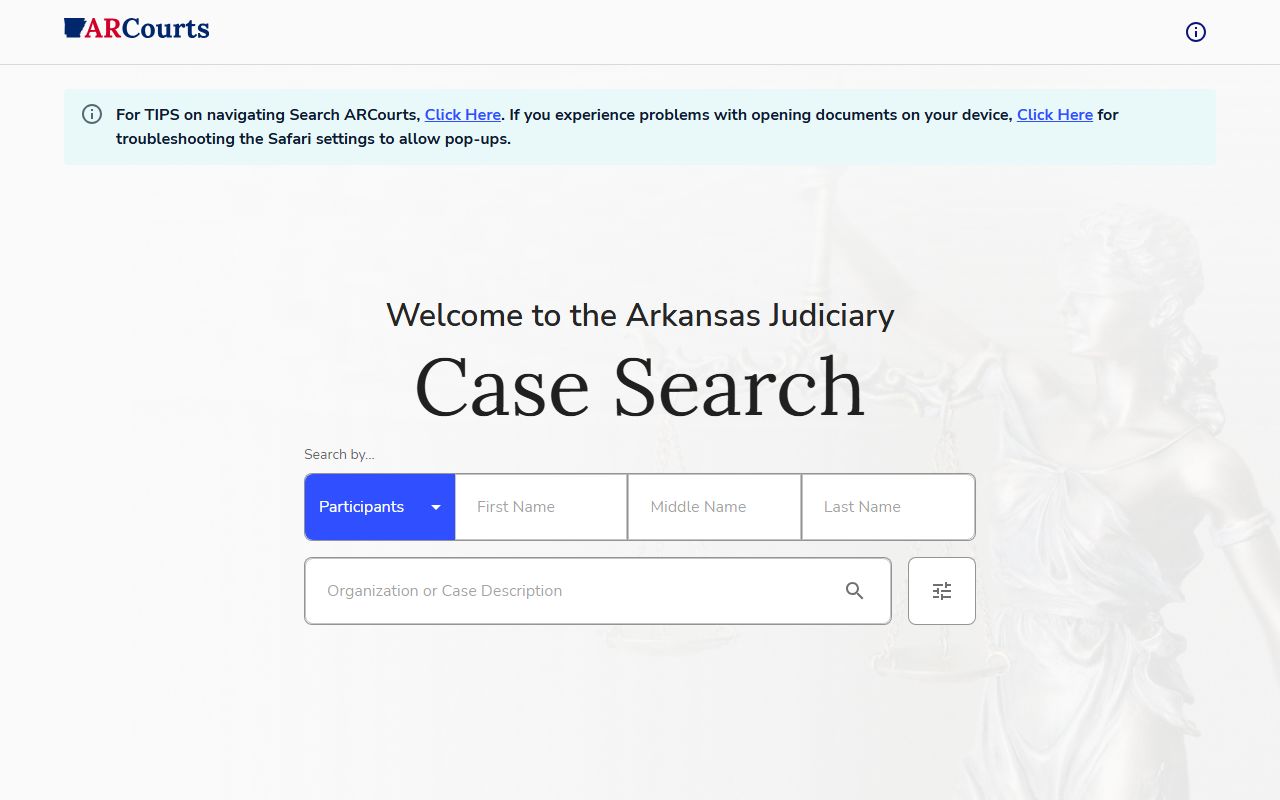
Use the portal for court case data, then contact the Circuit Clerk or District Court when a public case is missing, sealed, older, or not fully imaged online.
Johnson County Arrest Charging Documents
Charging documents are the bridge between the jail arrest and the court record. A person may be booked into Johnson County Detention Center on an arresting-agency charge, then appear before a judge for bond or an early hearing. The prosecutor then decides what charge to file in court. In felony matters, that formal charge is often filed by information. In some matters, a complaint or citation starts the case. An indictment is possible but is not the routine path for most local cases.
| Document | Who Files It | Typical Use | What to Check |
|---|---|---|---|
| Complaint or citation | Officer, agency, or prosecutor | District Court matters, citations, misdemeanors, or first case filings | Name, offense, date, court, and bond or appearance instructions |
| Information | Prosecuting Attorney | Common formal charging document for Arkansas felony cases | Count numbers, statute references, felony level, and amendments |
| Indictment | Grand jury | Possible for serious cases, but less common in routine county filings | Grand-jury count language and later docket entries |
The Johnson County Circuit Clerk maintains criminal court files, pending case records, past court files, dockets, and court-authorized writs, summonses, warrants, and subpoenas. The county identifies Monica King as Circuit Clerk and lists the clerk's phone as 479-754-2977. For District Court cases, the Johnson County District Court page lists Judge Sarah Capp, clerk Miranda Reardon, and phone (479) 754-8533. Address text for the District Court office is inconsistent in county material, so verify by phone before traveling.
Johnson County Charge Status
Charge status can change after an arrest. A roster entry may show theft, assault, probation violation, parole hold, failure to appear, or a controlled-substance charge as it was recorded at intake. The court file may later show a different count, a corrected statute, a reduced charge, an added count, or a dismissal. That is why court records after a jail arrest should be checked separately from the roster.
| Status | Plain Meaning | Reader Caution |
|---|---|---|
| Pending | The charge has been filed or is active, but no final disposition appears. | Check future court dates and bond conditions. |
| Amended | The prosecutor changed the charge wording, statute, count, or level. | Compare the amended count with the original booking charge. |
| Reduced | The filed charge was lowered to a less serious offense or count. | The current court docket controls over older roster wording. |
| Dismissed | The court ended that charge without a conviction on that count. | A dismissal is not the same as automatic sealing. |
| Nolle prosequi | The prosecutor declined to pursue the charge at that time. | Read the docket for whether any other counts remain. |
| Convicted | A guilty plea, finding, or judgment has been entered. | Use the judgment or disposition date, not the arrest date, for the outcome. |
Bond After Johnson County Arrest
Bond information often appears before the court case is fully built online. The Johnson County roster shows a bond amount when one is available, with observed entries showing amounts such as cash figures and a sheriff press release using the term "cash/commercial." The same roster also shows records where no bond is listed, especially when the person has a parole hold, probation issue, sentenced-to-ADC status, or another hold that can block release.
For Johnson County court records after an arrest, bond should be read as a court-controlled release issue. A District Judge may set bond at an early appearance. The roster can help identify the court, but the jail should still be called before anyone assumes that payment will result in release. A bond on one charge does not clear a detainer, parole hold, probation hold, or sentenced-state-custody status.
| Bond Type | How It Works | Local Check |
|---|---|---|
| Cash bond | The full amount is paid as required by the order. | Call the jail to confirm accepted payment methods. |
| Commercial or surety bond | A licensed bonding company posts bond under court rules. | Confirm whether the order permits a commercial bond. |
| PR or own recognizance | The court releases the person on a promise to appear. | No Johnson County web page was found listing eligibility rules. |
| No-bond hold | The person cannot be released on that matter by paying money. | Check for parole, probation, ADC, or outside-agency holds. |
Call the Johnson County Detention Center or Sheriff's Office at (479) 754-2200 for current bond and hold status. For District Court matters, call (479) 754-8533. For Circuit Court case-record questions, call the Circuit Clerk at 479-754-2977.
Johnson County Warrants and Court Records
No official complete Johnson County online active-warrant database was located. The sheriff does publish a Most Wanted page, but that is a selected public list, not the full warrant inventory. For warrants, the sheriff's FAQ directs people to call the Warrants Clerk at 754-2200 between 8:00 am and 4:00 pm Monday through Friday. The FAQ also says a person with a warrant may be able to make arrangements, clear the warrant, receive service, and get a court date rather than be jailed, depending on the matter.
Warrants can connect the jail record to the court file. A bench warrant often comes from a judge after a missed court date. A failure-to-appear charge may then show on the roster, while the court docket shows the older case and the warrant activity. A parole or probation warrant can also keep a person in custody after a new arrest, even when bond appears on the new charge.
- Arrest warrant
- A court order to arrest a person on a criminal matter.
- Bench warrant
- A judge-issued warrant, often tied to failure to appear or court-order violations.
- Detainer
- A hold or request from another agency that can delay release.
- Body attachment
- A custody order sometimes used in civil, support, or court-compliance matters.
Charge vs Conviction
An arrest charge is an accusation or booking reason. A conviction is a final court outcome based on a plea, finding, or judgment. Johnson County court records after an arrest may show both over time, but they should never be treated as the same thing. A person can be arrested and charged, then have a count dismissed, reduced, amended, or resolved without a conviction on that charge.
| Point of Comparison | Charge | Conviction |
|---|---|---|
| Stage | Filed accusation or booking allegation | Final judgment, plea, or finding |
| Proof level | Based on probable cause and prosecutor filing choices | Based on plea or proof beyond a reasonable doubt |
| Where it appears | Roster, complaint, information, or docket count | Disposition, judgment, sentence, or criminal-history record |
| Risk of misread | May later be changed or dropped | Still must be checked for appeal, sealing, or later orders |
Sealed vs Expunged Records
Arkansas uses criminal-record sealing procedures for eligible records under the Comprehensive Criminal Record Sealing Act of 2013, cited in the research as Ark. Code Ann. Section 16-90-1401 et seq. The practical result is limited public access to eligible criminal records after a court grants relief. Search ARCourts may hide, limit, or omit case details when a case is sealed, juvenile, confidential, or otherwise restricted by law.
| Point of Comparison | Sealed | Expunged |
|---|---|---|
| Public access | Limited or removed from ordinary public view | Often used casually to mean cleared, but Arkansas research points to sealing as the statutory route |
| Agency access | Some courts, law-enforcement, or authorized agencies may retain access | Do not assume all government access ends |
| How it happens | Requires eligible case status and a court order | Requires the specific legal process that applies to the record |
| Effect on searches | Public portal results may be limited or absent | Older public copies may still need direct correction or removal requests |
Arkansas FOIA, including Ark. Code Ann. Section 25-19-105, generally opens public records for inspection and copying during regular business hours unless an exemption applies. Sealing is one of the reasons a court or agency may limit what the public can see.
Restricted Johnson County Court Records
Not every court record after an arrest is public in full. Juvenile matters, sealed files, confidential victim information, certain mental-health or treatment details, active investigative material, and records covered by a court order may be withheld or redacted. Some documents may exist at the clerk's office even when they do not appear in Search ARCourts, while other records may be unavailable to the general public because the case is legally restricted.
For older files, certified copies, and court records not online, contact the Johnson County Circuit Clerk. The county's courts page lists Circuit Court divisions and District Court contacts. For District Court citations, traffic matters, misdemeanor hearings, and District Court warrants, contact District Court. The clerk and court staff can answer records-process questions, but they cannot give legal advice or predict what a prosecutor or judge will do.
Important: Public case lookup is not an FCRA consumer report and should not be used for employment, tenant, credit, insurance, or similar screening.
Public Record Search
Sponsored Results